Architecture Computational Technologies
Explore design research at the frontiers of architecture through experimentation in computational design, robotic systems applied to fabrication and interactivity, and materiality. For more information please contact ms.act@nyit.edu
ENTANGLED ECOLOGIES of the PUBLIC REALM, Lecture by Marcella del Signore
Blog | Mar 08, 2022
March 14th 2022 2 p.m. – 3 p.m. EDT via zoom
ENTANGLED ECOLOGIES of the PUBLIC REALM
Lecture by
Marcella del Signore,
Associate Professor; Director, MS. inArchitecture, Urban Design; Principal, X-Topia
The exploration of the public domain is an important parameter to define how we live as collective and how we can rethink the fundamentals of living. The public realm is an expanded field where the deployment of collective ecologies is inherently connected to the socio-cultural production of space and forms of cohabitation of living systems. The talk addresses the intersection of technologies with the public/social/cultural realm through prototyping, material and fabricated systems, data-driven protocols, and mediated environments. Starting from Aério, an installation recently exhibited at the 17th Venice Architecture Biennale, a series of projects will be the vehicle to speculate on the current and future states of socio-technical apparatuses, interlaced ecosystems, and planetary entanglements.
Read More
Automation in Development through Collectives MS ACT Program Lecture Event SoAD
Blog | Mar 02, 2022
“Automation in Development through Collectives“
MS in Architecture, Computational Technologies Program Lecture
Introduction and moderation:
Pablo Lorenzo-Eiroa, Director,
MS in Architecture, Computational Technologies Program (MS_ACT) SoAD at NYIT
andra Manninger, Assistant Professor, MS ACT, SoAD at NYIT
Speakers:
“Site Surveying”
Maider Llaguno-Munitxa, Assistant Professor UCLouvain
“Designing Behaviors”
Evangelos Pantazis, IBI Group / Topotheque Design Research
“Natural Smartness: A new Era in Sustainability”
Hanaa Dahy, Jun.-Prof. Dr.-Ing. M.Eng. Arch. Hanaa Dahy, BioMat Director at ITKE, Faculty of Architecture and Urban Planning, University of Stuttgart.
“Architecture's Sputnik Moment”
Neil Leach, Director, FIU DDes
Read More
MS in Architecture, Computational Technologies Program Information Session Fall 2022
Blog | Feb 23, 2022
Video of Information Session 2021 explaining the MS ACT Program by
Director Pablo Lorenzo-Eiroa. The video contains partial information and
content that may be out of date. The Program may be modified for Fall
2022 pending approvals.
Read More
Panoramas of Cinema: Image Search Lecture by Jorge Orozco, Dr. Sc. ETHZ
Blog | Feb 07, 2022
MS_ACT
Master of science in architecture,
computational technologies
MS_ACT LECTURE SERIES S2022
Informed actualizations: From AI to physical computation
The MS ACT Lecture Series aims at discussing research framed by invited guest speakers. The MS ACT Program focuses on architecture expanding relationships between science, technology and culture through innovation in algorithms, simulations, ai, robotics, robotic fabrication and materials. The spring 2022 lecture series discusses alternative means to understand the dialectics between the ideal digital and the physical digital. Within an architecture of information, ai, robotics and materials are thought as actualization interfaces. This process understands information flows and their actualizations as architecture.
Read More
Buckminster Fuller's trajectory - Dymaxion to the Geo Lecture by Michael Wen Sen Su, Pratt Institute
Blog | Feb 02, 2022
MS_ACT LECTURE SERIES S2022
LECTURE: February 14 2022 2 p.m. – 3 p.m. est via zoom
Of Houses and Surfaces: Re-tracing, and re-thinking, R.
Buckminster Fuller's trajectory from the Dymaxion to the Geo
Michael Wen Sen Su, Adjunct Associate Professor, Pratt Institute School of Architecture
Despite his lack of formal architectural training, R. Buckminster Fuller's contribution to architecture has been profound and unmatched. While his life's work is well studied, due, in no small part, to his lifelong drive to document every aspect and conserve every correspondence of his life, this lecture seeks to re-trace, and thereby to re-think, the trajectory of his work, which was marked at its inception by his idiosyncratic, impossible Dymaxion House, and at its terminus by the fanciful, all too possible Geodesic dome. In particular, this lecture seeks to reconsider Fuller as the innate outsider whose uncanny capacity for thinking outside the box led him to conceive of architecture not merely as the provision of shelter or the control of environment, but as the synthesis and manipulation of information.
Read More
MASTER’S IN ARCHITECTURE, COMPUTATIONAL TECHNOLOGIES PROGRAM IS TAKING ARCHITECTURE INTO THE FUTURE
Blog | Jan 20, 2022
Today, students in New York Tech’s M.S. in Architecture, Computational Technologies (M.S.ACT) degree program are inventing new ways to look at architecture. It’s all happening through artificial intelligence (AI) and robotic systems and being applied in exciting ways that could impact architecture and, more broadly, environmental systems for the next several decades.
Read More
INFORMED REALISM ARCH 701B Studio Final Review Prof. PABLO LORENZO-EIROA
Blog | Dec 23, 2021
An Informed Realism becomes active once survey is understood as an act of design. Questioning representation parameters in architecture, students address how computation can be understood as proto-architectural. From Big Data gathering, to emergent computation through simulation, to activating artificial intelligence (Data Science, Simulation, Machine Learning), to an augmented virtual reality, students are asked to develop ideas through specific computational thinking, learning and investigating through technology specific cultural problems.
Read More
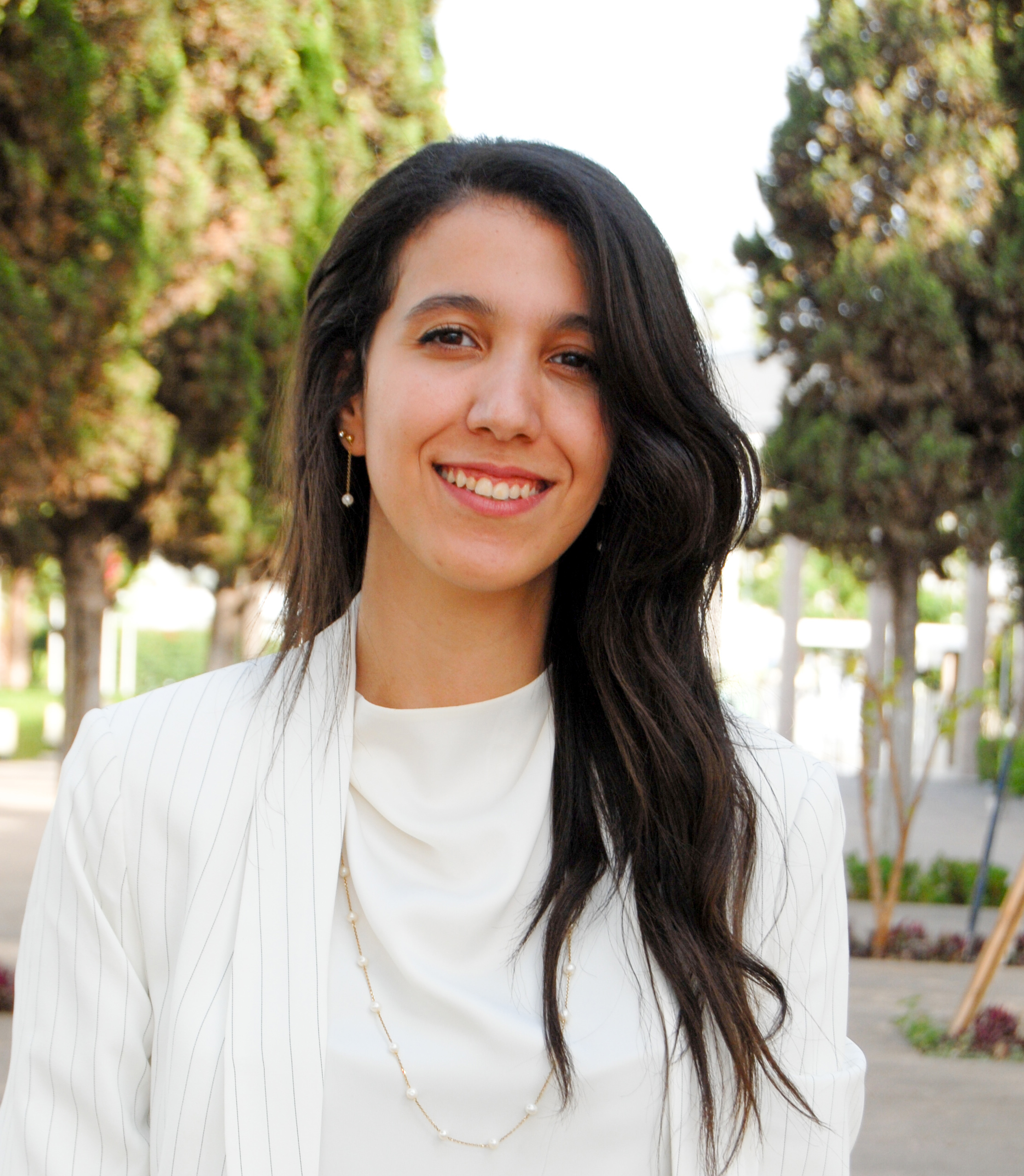
Interview with Salma Kattass by MSACT
Blog | Nov 21, 2021
Salma Kattass is a Fulbright grantee in the Masters in Architecture, Computational Technology program here at NYIT. She graduated from the National School of Architecture Rabat, Morocco in 2019. After her undergraduate degree she occupied a position of an architect project manager at an architectural firm in Casablanca where she worked on projects of multiple scales ranging from private residences to office buildings to public parks. Furthermore, Salma participated in many national and international competitions as a student, a young architect and designer where she received several awards.
Read More
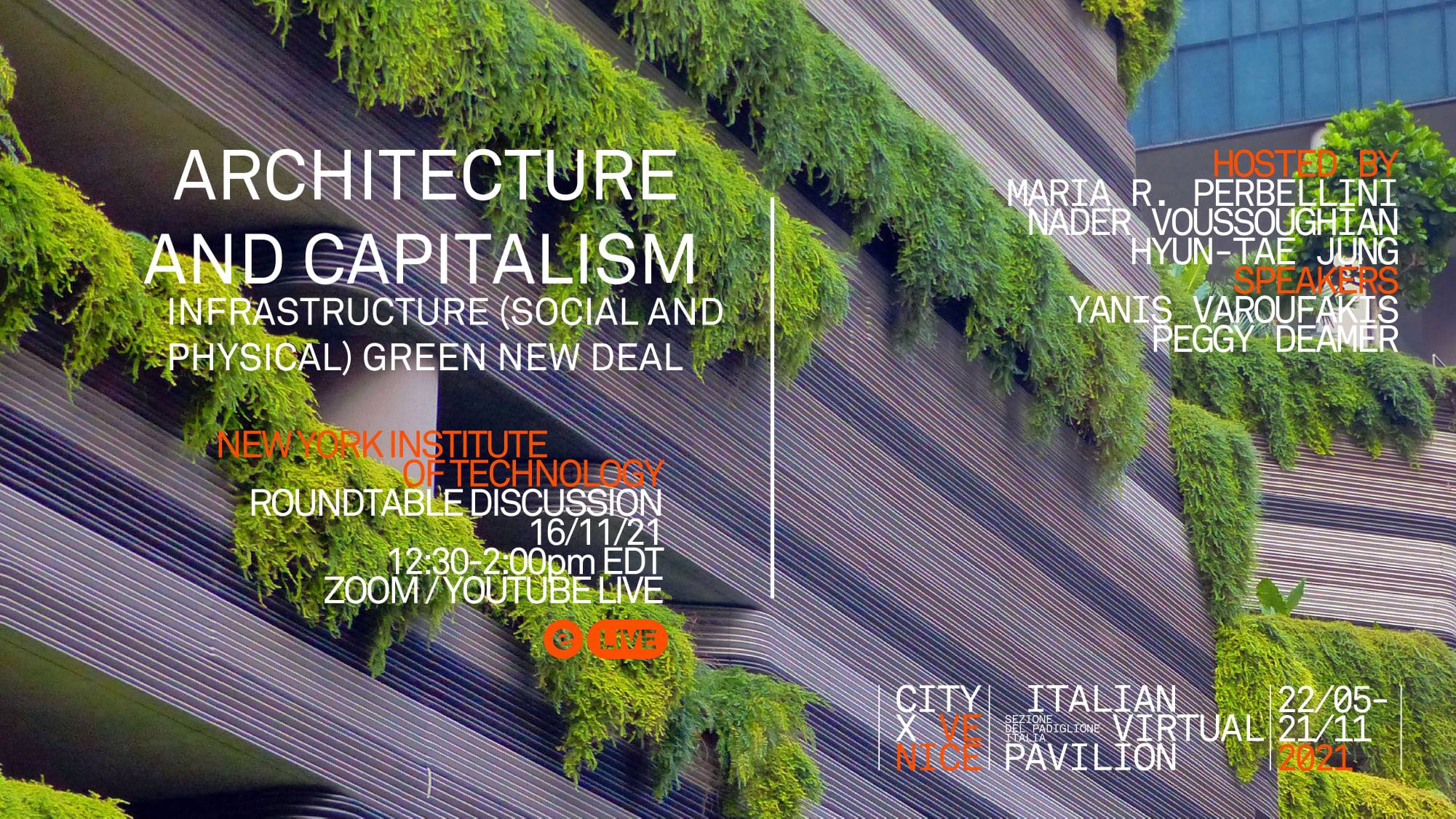
ARCHITECTURE And CAPITALISM Lecture YANIS VAROUFAKIS, PEGGY DEAMER,
Blog | Nov 21, 2021
This is a discussion of architecture’s role in capitalism and the manner in which it is circumscribed by capitalism and furthers capitalism’s agenda. In discussion with Nader Vossoughian, Hyun-Tae Jung and Yanis Varoufakis, we will examine the role that building can play in remedying the economic, biological, and social crises facing so many nations today. We will talk about its importance to the future of the public sphere, not just from a political point of view but also from an ecological and humanitarian standpoint. We will debate the ongoing challenges that monopoly capitalism poses to our life on this planet.
We will consider some of the theories of infrastructure current in artistic and policy-related circles. We will assess the merits of the Green New Deal, which pairs labor programs together with the climate crisis. And we will examine activist movements taking root in various parts of the world.
Read More
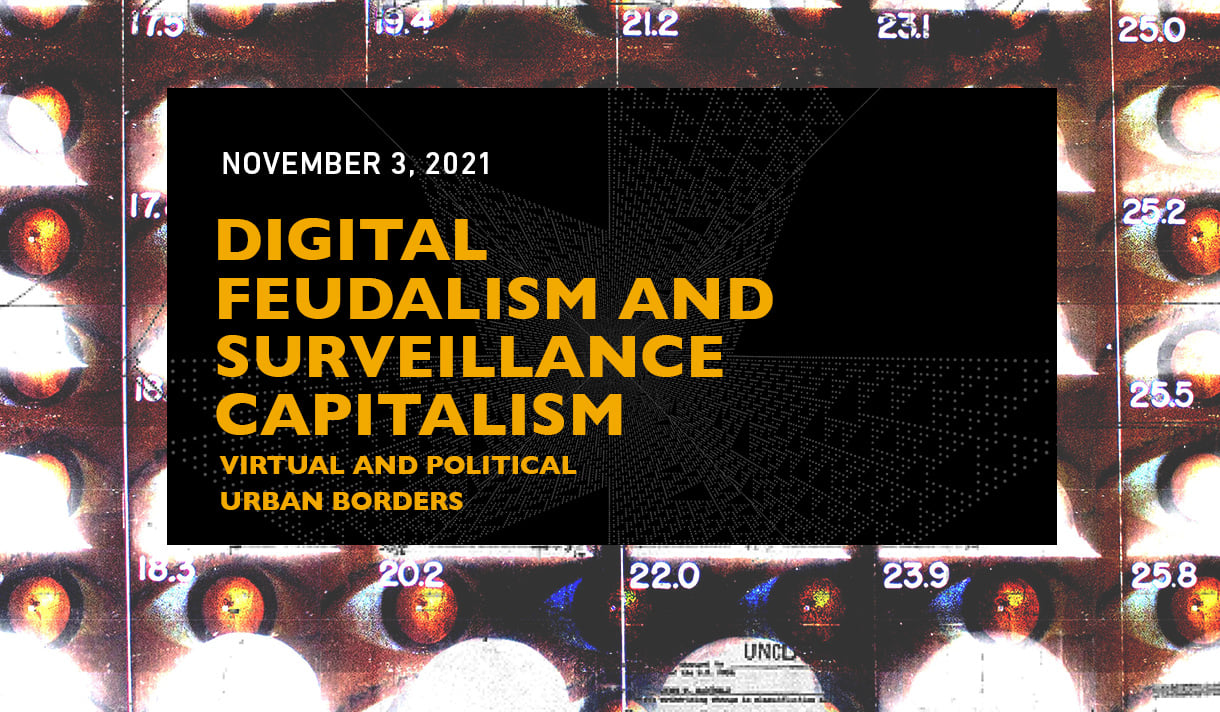
DIGITAL FEUDALISM AND SURVEILANCE Lecture SEAN ANDERSON, JANA LEO, M7red, ZULAIKHA AYUB
Blog | Nov 18, 2021
Borders and cities index more an economic system than the previous modern ideals of socio economic stability, health and equity. These economic systems are measurable in how the city form follows finance (Willis) rather than environmental, urban and architecture parameters. What are the consequences of Capitalism in architecture and urbanism? How can we denaturalize cities as business and present alternative scenarios? In a globalized economy, people cannot move but goods can. How can we disclose implicit and explicit political boundaries in the current neoliberal model? What are the possibilities for a Post-Capitalist Urbanism in the Post-Anthropocene? How is technology enabling or resisting these processes? How is the current Feudal Capitalism in Computation reinforcing or displacing this logic and physical and political borders?
Read More