Build Ahead
What AI’s “Hardware Lottery” Reveals About Construction
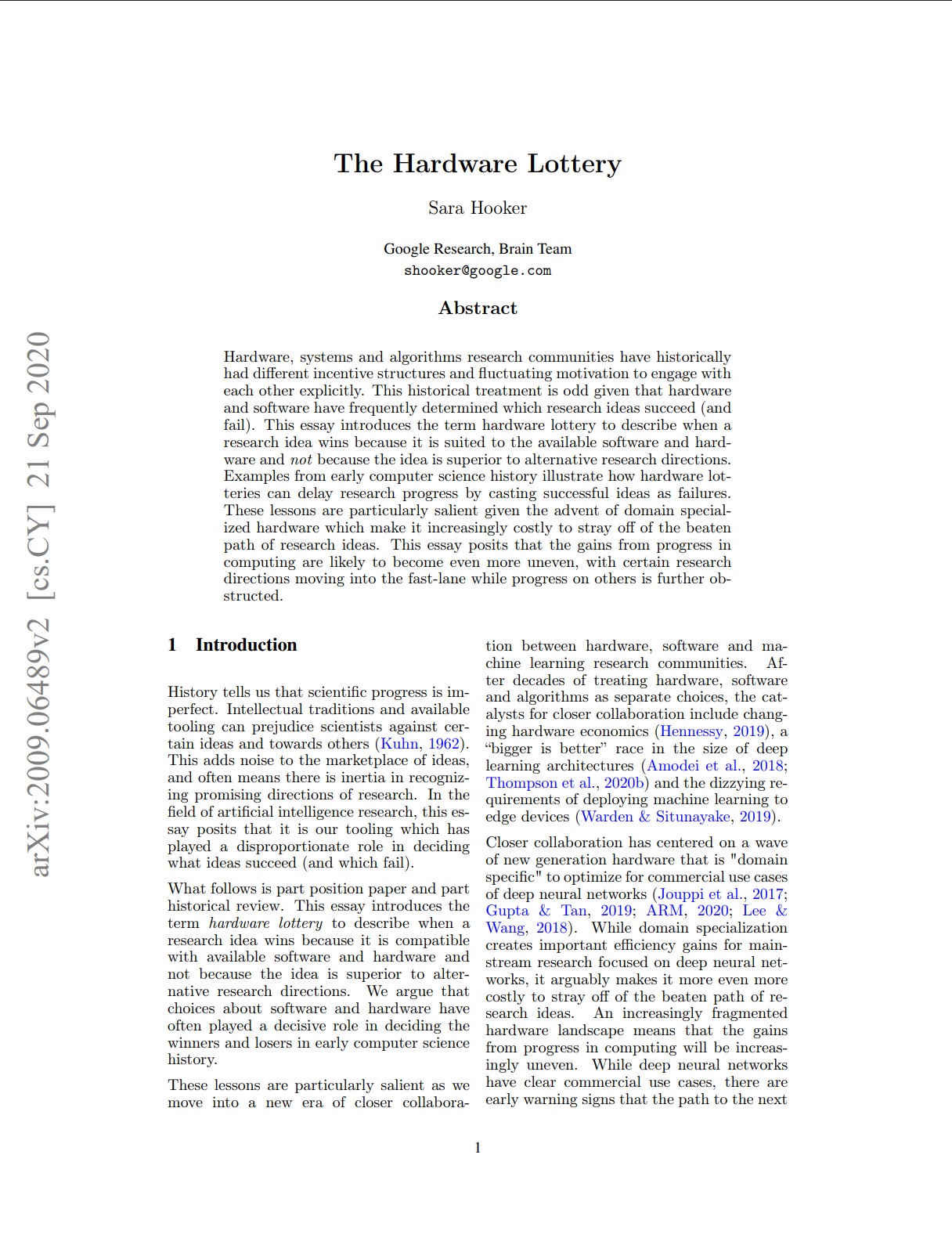
A few years ago, Google researcher Sara Hooker introduced a useful phrase: the hardware lottery. Her argument was simple but unsettling. In the history of artificial intelligence, ideas have often succeeded not because they were inherently superior, but because they happened to fit the available hardware and software of their moment. Other equally promising ideas, stalled for years because the surrounding tooling was not yet ready to let them prove themselves.
Sara's idea deserves a wider audience, because it does not only apply to AI. Construction has its own version of this phenomenon. At the CfOC, we call it a delivery-stack lottery. (You can see our debt to Sara, we called the second chapter of From Handshake to Hardware “The Administrative Stack Behind ETO Construction.” )
In construction, methods often win not because they are inherently superior, but because they fit the incumbent delivery stack of contracts, codes, labor practices, software, review pathways, and interfaces. A method may be technically sound, economically promising, and even better suited to the future needs of housing delivery. But if it does not fit the surrounding system, it can still appear impractical, risky, or immature.
This explains a recurring problem in offsite construction. The industry often debates whether modular methods “work,” as if the answer lies in the object itself. But a building method is never judged alone. It is judged together with the permitting pathways around it, the trade scopes that install it, the legal forms that govern it, the software that describes it, the transport systems that move it, and the interface standards that allow it to connect to the larger building. When those surrounding systems are poorly aligned, the method may look like the problem even when the deeper problem is the stack around it.
That is why the Center for Offsite Construction has spent so much time arguing that industrialized construction is not simply a matter of making better parts. It also requires better conditions for combination. Stable interfaces. Clearer handoffs. Review pathways that understand repeatable systems. Contract structures that match manufactured products rather than bespoke services. Digital tools that describe what products are, how they connect, and where their proper use begins and ends.
Without those conditions, the industry produces false negatives. Good ideas are judged too early, or under the wrong conditions, and dismissed as failures. We have seen this repeatedly in the history of offsite construction. Methods that promise speed, quality, and repeatability are inserted into a delivery environment still optimized for bespoke coordination. Predictably, they inherit friction. Then the friction is blamed on modularity itself.
This is one reason the Center’s work has focused on the deeper infrastructure of an offsite marketplace. Our standards efforts aim to make interfaces more dependable across firms and projects. Our writing on legal frameworks asks whether a product-based industry can continue to rely on agreements developed for bespoke professional services. Our work on configurator file types asks how products can publish their rules, constraints, and allowable combinations in forms that software and AI tools can actually use. None of this is peripheral. It is the groundwork required to reduce the cost of trying better combinations.
That is the deeper lesson. The point of standards, agreements, and digital description aims to amplify discovery. These tools make it easier for the industry to see which ideas are actually strong, because they reduce the noise introduced by a poorly matched delivery environment.
The future of offsite construction will be won by the methods that can be clearly described, fairly reviewed, reliably connected, and commercially transacted inside a more coherent delivery stack. That is why the Center continues to focus not only on products, but on the systems that allow products to become a marketplace.
The hardware lottery helped explain why some ideas in AI arrived late. We're amplifying those learnings to describe the delivery-stack lottery that AEC faces. Together, we can explain why construction still struggles to recognize some of its most important next steps.
(Editor's Note: Many thanks to frind of the CfOC – Josh Lobel (AutoDesk) – for originally bringing Sara's work to our attention!)
More Posts
All PostsSep 01, 2026
CfOC Joins the US TAG to ISO/TC 59 and SC 19
Jul 15, 2026