Build Ahead
HUD Has Named the Work Ahead for Offsite Construction. Now We Need to Build the Infrastructure.
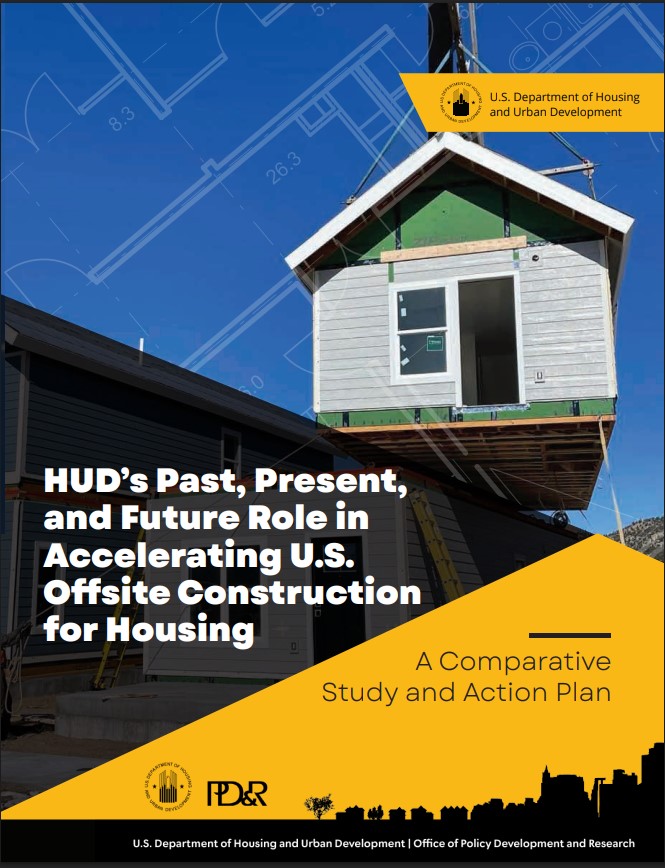
The U.S. Department of Housing and Urban Development has released an important new report: HUD’s Past, Present, and Future Role in Accelerating U.S. Offsite Construction for Housing: A Comparative Study and Action Plan. For those of us working to modernize housing delivery, the report deserves careful attention. It does more than express general enthusiasm for offsite construction. It studies prior federal efforts, compares international precedents, and proposes an action plan organized around the institutional conditions required for offsite construction to scale.
For decades, offsite construction has too often been discussed as a narrow question of building technology. Can modules be stacked faster? Can panels be cut more precisely? Can factories reduce waste? Can pods improve quality? These are useful questions, but they do not reach the full problem. HUD’s report returns to a deeper lesson that has appeared repeatedly in the history of industrialized housing: the primary barriers are often institutional. The report cites the Operation Breakthrough-era insight that the large-scale use of industrialized building systems was limited less by technology, design, or cost than by institutional constraints.
Yes! That observation lands squarely within the work the Center for Offsite Construction has been pursuing.
At the CfOC, we have been studying the same problem from the level of standards, contracts, software, professional education, and market formation. Our conclusion has been consistent: offsite construction cannot reach its full potential if every project must be reinvented, renegotiated, reinterpreted, and reapproved from scratch. Industrialized delivery needs repeatable products, repeatable interfaces, repeatable rules, repeatable forms of acceptance, and repeatable ways to describe what a product can and cannot do.
HUD’s new report gives this agenda a strong federal frame. It identifies three linked strategies: standard award criteria in the immediate term, housing system certification in the intermediate term, and performance-based building codes in the long term. It also argues that these strategies should be pursued concurrently because they reinforce one another. The CfOC sees HUD's report as a clear opportunity for organizations to help translate policy direction into working infrastructure.
A Federal Agenda That Aligns With the CfOC’s Roadmap
HUD’s report places offsite construction within a broader transition toward industrialized construction, industrialized housing delivery, high-technology housing, and a national innovation system. That language shifts the conversation away from isolated demonstrations and toward market formation. A high-performing offsite sector a surrounding ecosystem that can support factories: standards bodies, certification pathways, building officials, finance and insurance partners, trained professionals, public agencies, digital tools, and contracting practices that understand how manufactured building products move from design intent to physical delivery.
- This is where HUD’s agenda and the CfOC’s research roadmap strongly converge. The CfOC’s work on CfOC-ICC-1220 is aimed at standardizing interfaces between offsite construction products and building-service systems. The project asks a practical but consequential question: what must be true at the boundary between a manufactured building product and the building into which it is installed? Plumbing, venting, electrical, access, clearance, inspection, and acceptance all become part of that question.
- The CfOC’s work on the CTO File Type and the related CTO Interface Standard (CIS) asks a parallel question in digital form: how should manufactured building products describe their allowable configurations, constraints, and interfaces so that configurators, design tools, and eventually review systems can understand them? If future housing systems are to be certified, financed, insured, and inspected more predictably, then the information describing those systems must become more structured, more portable, and more machine-readable.
- The CfOC’s Handshake project addresses another part of the same institutional landscape: contracting. Offsite construction changes when value is created, where work occurs, who has custody of the product, when acceptance should happen, when title and risk should transfer, and how payment should be released. Conventional construction contracts struggle with these realities because they were built around site-based, project-specific delivery. Handshake explores standard forms of agreement, schedules of values, staged acceptance, and chain-of-custody logic better matched to offsite construction.
- The CfOC’s emerging work on CfOC-ICC-1230 extends the standards agenda to panel-to-panel and panel-to-structure interfaces. As HUD’s report makes clear, regulatory reform and standards must operate together if offsite construction is to scale. Interface standards can help turn offsite construction from a collection of one-off project solutions into a more predictable market of compatible products.
Together, these projects reflect a simple premise: HUD’s agenda requires implementation tools. The CfOC is building those tools in public-facing, consensus-oriented, and research-driven ways.
Demand Aggregation and Regulatory Reform Must Move Together
One of the strongest arguments in HUD’s report is that regulatory reform and demand aggregation are both necessary. The report warns that regulatory reform without demand aggregation may remove barriers but fail to generate supply quickly. It also warns that demand aggregation without regulatory reform can create an offsite sector that remains fragile, subsidy-dependent, and vulnerable to quality problems or market stigma. We agree!
- Manufacturing requires pipeline. Factories need enough predictable work to justify investment in people, equipment, process improvement, quality systems, and product development. Fragmented demand forces manufacturers back into project-by-project customization, which erodes the benefits of offsite construction.
- Even the strongest pipeline cannot scale efficiently if every jurisdiction, project team, lender, insurer, and contract treats the same product as a new experiment. Offsite construction becomes expensive when its repeatable elements are not recognized as repeatable.
The two reforms are mutually reinforcing. Demand aggregation gives manufacturers a reason to standardize. Regulatory reform gives public agencies, owners, and private partners confidence that standardized products can move through approval, financing, insurance, installation, and acceptance without excessive friction.
This is also why the CfOC has focused so heavily on market infrastructure. Interface standards, digital file types, contracting templates, and acceptance procedures are the practical connective tissue between regulatory reform and demand aggregation. They help make repeatability legible.
HUD’s Immediate Strategy: Standard Award Criteria
HUD’s immediate recommendation is the development of standard award criteria across federal programs that affect offsite construction. The goal is to use existing and future federal funding in a more coordinated way, so that public dollars create clearer demand signals for the offsite sector. The CfOC finds this to be one of the most actionable ideas in the report.
Federal housing programs often influence the market even when they are not directly procuring housing. Award criteria shape what applicants propose, what public agencies value, what private partners organize around, and what kinds of capacity the market develops. If award criteria remain scattered, vague, or inconsistent, the market receives scattered, vague, and inconsistent signals.
The CfOC sees a strong opportunity to help make award criteria more precise without making them overly restrictive. Federal programs can favor measurable delivery behaviors. For example:
- Projects could be rewarded for using standardized interfaces.
- They could be rewarded for documenting the percentage and value of work completed off site.
- They could be rewarded for using structured product data that can be reviewed across design, procurement, manufacturing, installation, inspection, and acceptance.
- They could be rewarded for defining acceptance checkpoints before work begins.
- They could be rewarded for demonstrating how repeatable products will reduce project uncertainty across multiple sites or future projects.
This approach respects technological neutrality while still requiring evidence of industrialized delivery discipline. It avoids the trap of treating every offsite proposal as equally mature merely because some portion of the work occurs in a factory.
The CfOC is eager to take this agenda further by developing model award criteria tied to standards, digital product data, contracting logic, and performance documentation. That work would make HUD’s immediate strategy easier for federal agencies, state housing agencies, local governments, and nonprofit applicants to use.
HUD’s Intermediate Strategy: Housing System Certification
The report explains that many complex products in the modern economy are regulated at the system or product level, while housing is still typically reviewed project by project. Housing system certification would create a more appropriate pathway for industrialized housing systems by defining performance criteria and allowing certified systems to be configured for specific uses and sites. For the CfOC, this is where the digital and standards agenda becomes unavoidable.
A housing system certification program will need information infrastructure. It will need to know what a system is, what parts vary, what parts remain fixed, what interfaces are allowed, what performance claims have been tested, what configurations fall inside or outside the certified boundary, and what evidence must travel with the product from design through installation.
This is a welcome rewording of the problem the CTO File Type is being developed to address. “Configure-to-Order” describes a delivery environment in which users select from defined options inside a governed product system. A CTO product can vary, but it does not vary infinitely. Its options, dimensions, interfaces, performance assumptions, and installation rules are constrained in advance. That constraint is what makes it scalable.
HUD’s term “Industrialized Housing Delivery” describes the broader delivery transformation. CfOC’s CTO framework helps define one implementation pathway for that transformation. If housing system certification is to work, then certified housing systems will need a way to express their rules. They will need to say, in structured form, what is allowed, what is prohibited, what must be checked, and what evidence is required.
This is the next frontier of offsite construction research. Certification cannot rely only on narrative manuals, static drawings, and human interpretation. It will need machine-readable product logic that can support configurators, design review, procurement, quality assurance, inspection, and acceptance.
HUD’s Long-Term Strategy: Performance-Based Building Codes
HUD’s long-term recommendation is the development of a performance-based building code framework. The report argues that performance-based codes can support innovation by focusing on what a building material, component, or system must accomplish rather than prescribing only how that performance must be achieved. The CfOC strongly supports this direction.
Performance-based regulation is important because industrialized construction often improves by changing means and methods. A prescriptive environment can unintentionally freeze older ways of building into the regulatory structure. A performance-based environment can make room for better products, better assemblies, better interfaces, better evidence, and better quality systems.
At the same time, the path to performance-based codes will require intermediate tools. The United States is a fragmented regulatory environment. State and local adoption patterns vary. Authorities having jurisdiction have different capacities, staffing levels, risk tolerances, and review cultures. A national performance-based code framework would be a major undertaking.
Interface standards can serve as practical bridges, here. CfOC-ICC-1220 and CfOC-ICC-1230 do not require the entire regulatory environment to transform at once. They can define specific, repeatable interface conditions that become easier to reference, test, inspect, and improve. They can help offsite products behave more predictably within existing regulatory systems while creating a foundation for more performance-based approaches over time.
In other words, performance-based codes may be the long-term horizon, while interface standards can become near-term instruments. They can help the market learn how to evaluate repeatable offsite conditions before a full regulatory transformation occurs.
The Missing Layer: Digital Market Infrastructure
Offsite construction depends on decisions made earlier than conventional construction. A manufactured product must be defined, priced, coordinated, produced, shipped, installed, inspected, and accepted with fewer opportunities for improvisation. That requires better information at the beginning of the process.
Digital configurators can help, but only if the products inside those configurators are governed by reliable rules. A configurator that generates attractive options without enforceable product constraints can create false certainty. A configurator that understands a product’s allowed dimensions, interfaces, tolerances, utility connections, inspection requirements, and installation sequence can become a serious delivery tool.
That is why the CfOC’s CTO File Type and CIS work are so important. They aim to make product rules portable. They allow a manufactured building product to carry its constraints into digital environments. Over time, this could support award criteria, certification, design review, permitting, procurement, contracting, and inspection.
This is also where the CfOC’s work can help public agencies. Government programs need evidence. They need comparable metrics. They need criteria that can be reviewed fairly. They need to know whether a proposal is genuinely industrialized or simply using offsite language. Structured product data can help make those distinctions visible.
Contracts Are Part of the Infrastructure
Contracts are often treated as administrative documents that follow technical decisions. In offsite construction, contracts are part of the technical system. They determine when a product is ordered, when manufacturing can begin, when changes are allowed, when work is accepted, when payment is released, who bears risk during shipping or staging, who has custody during installation, and what happens when site conditions conflict with manufactured product assumptions.
If the contract structure remains conventional, the delivery model remains conventional. That is one reason offsite projects can appear more difficult than they need to be. The physical product may be industrialized, while the legal and payment structure still assumes a bespoke site-built process.
Handshake is the CfOC’s effort to address that gap. It explores how offsite construction might require new standard forms of agreement, new schedules of values, clearer acceptance points, and more explicit chain-of-custody logic. This is not merely a legal exercise. It is part of the same institutional infrastructure HUD identifies throughout its report.
A future housing system certification program will need contract pathways. Standard award criteria will need procurement language. Performance-based delivery will need clear evidence and acceptance procedures. Lenders and insurers will need to understand where value is created and when risk changes hands.
A National Innovation System Requires Builders of Infrastructure
HUD’s report repeatedly returns to the idea of a high-technology housing sector supported by a national innovation system. It defines that system as a network of public and private institutions whose activities help initiate, import, and diffuse new technologies. This concept is central to the CfOC’s mission.
A national innovation system does not emerge from enthusiasm alone. It requires organizations that can do slow, difficult, connective work. It requires convening. It requires shared language. It requires neutral forums where producers, users, regulators, academics, nonprofits, and public agencies can work through technical details. It requires standards. It requires open intellectual infrastructure. It requires education and professional formation. It requires the patience to turn a compelling concept into procedures that other people can actually use.
Yes! The Center was founded to help create the institutional infrastructure needed for offsite construction to mature. We are encouraged to see HUD’s report place many of the same issues at the center of a federal action plan. The report confirms that the future of offsite construction will depend not only on better factories, but on better systems around those factories.
Three Grant Directions Worth Pursuing
HUD’s report creates an opening for the next phase of implementation. The CfOC sees at least three areas where future HUD-supported research, or research supported by aligned federal, state, philanthropic, and industry partners, could be catalytic.
1. Standards-to-Field Demonstration Grant
The first opportunity is a standards-to-field demonstration program focused on offsite construction interfaces.
This grant would support the continued development and practical testing of CfOC-ICC-1220, CfOC-ICC-1230, and the CTO Interface Standard. The goal would be to connect standards writing with field evidence. Interface standards should be tested not only in committee rooms, but in real design, manufacturing, installation, inspection, and acceptance contexts.
The work could include prototype interface documentation, installer feedback, AHJ review, manufacturer input, inspection protocols, and lessons learned from applying draft standards to actual pod, panel, and building-service conditions. It could also produce public-facing implementation guides for agencies and project teams considering offsite construction.
This would directly advance HUD’s priorities around regulatory reform, standards and system performance, and industrialized delivery. It would help create the practical bridge between national policy goals and the day-to-day work of getting offsite products approved and installed.
2. Digital Infrastructure for Housing System Certification Grant
The second opportunity is a digital infrastructure grant focused on the CTO File Type and the data requirements of future housing system certification.
HUD’s report calls for housing system certification as an intermediate strategy. For that strategy to work, certified systems will need structured information. They will need digital descriptions of product rules, allowable configurations, interface conditions, performance evidence, manufacturing constraints, inspection points, and acceptance requirements.
This grant would support the development of open technical specifications, sample product files, reference workflows, and prototype tools that show how manufactured building products can describe themselves in a way that configurators, agencies, designers, manufacturers, and reviewers can use.
The outcome would be a stronger foundation for future certification. It would also support standard award criteria by giving reviewers better ways to distinguish mature industrialized delivery systems from less developed proposals.
This work would take HUD’s system certification agenda further by giving it a digital backbone.
3. Offsite Contracting and Acceptance Infrastructure Grant
The third opportunity is a contracting and acceptance infrastructure grant based on the CfOC’s Handshake work.
This grant would support the development, review, and pilot use of offsite-specific contracting instruments. The work could include model agreement language, product-level schedules of values, staged acceptance procedures, chain-of-custody templates, title and risk-transfer logic, and coordination with finance and insurance stakeholders.
The goal would be to give public agencies, developers, manufacturers, contractors, lenders, insurers, and attorneys a clearer framework for offsite construction transactions. That framework would reduce ambiguity and support more predictable delivery.
This is a necessary complement to HUD’s technical agenda. Standards define what products and interfaces must do. Digital files describe how products can be configured and reviewed. Contracts define how parties rely on those products, pay for them, accept them, and allocate risk.
Offsite construction needs all three.
From Diagnosis to Implementation
HUD’s report is important because it names the work ahead with unusual clarity. It recognizes that offsite construction depends on institutional reform. It recognizes that demand aggregation and regulatory reform must move together. It recognizes that housing system certification and performance-based codes can help create a more innovative housing sector. It recognizes that a national innovation system requires partnerships among government, industry, academia, and nonprofit organizations.
We have been working on these problems from the bottom up: interface by interface, file type by file type, contract clause by contract clause, and roadmap project by roadmap project. HUD’s report gives the broader national context for that work. It also creates an opportunity for the next phase of partnership.
The United States does not need another generation of isolated demonstrations that prove offsite construction can work under exceptional conditions. It needs the infrastructure that allows offsite construction to work under ordinary conditions, across many projects, many jurisdictions, many product types, and many public and private partners.
That infrastructure will include standards. It will include digital configuration rules. It will include certification pathways. It will include contracts and acceptance procedures. It will include education. It will include public agencies willing to coordinate demand and reward maturity. It will include industry partners willing to build repeatable products rather than project-specific exceptions.
HUD has helped name the agenda. The CfOC is ready to help build the tools.
More Posts
All Posts