Build Ahead
From Handshake to Hardware to Data Standard: How Legal Ideas Became Machine-Readable
When CfOC published From Handshake to Hardware last year, we set out to document something the offsite construction industry had long felt but never fully articulated: that the legal infrastructure surrounding offsite products was fundamentally mismatched with the way those products actually move through the world. A bathroom pod manufactured in Maine, shipped to a jobsite in Massachusetts, crane-lifted onto a foundation, and accepted by a buyer travels through at least four distinct legal regimes on that journey — and until recently, not a single one of those transitions was documented in any standard, machine-readable way.
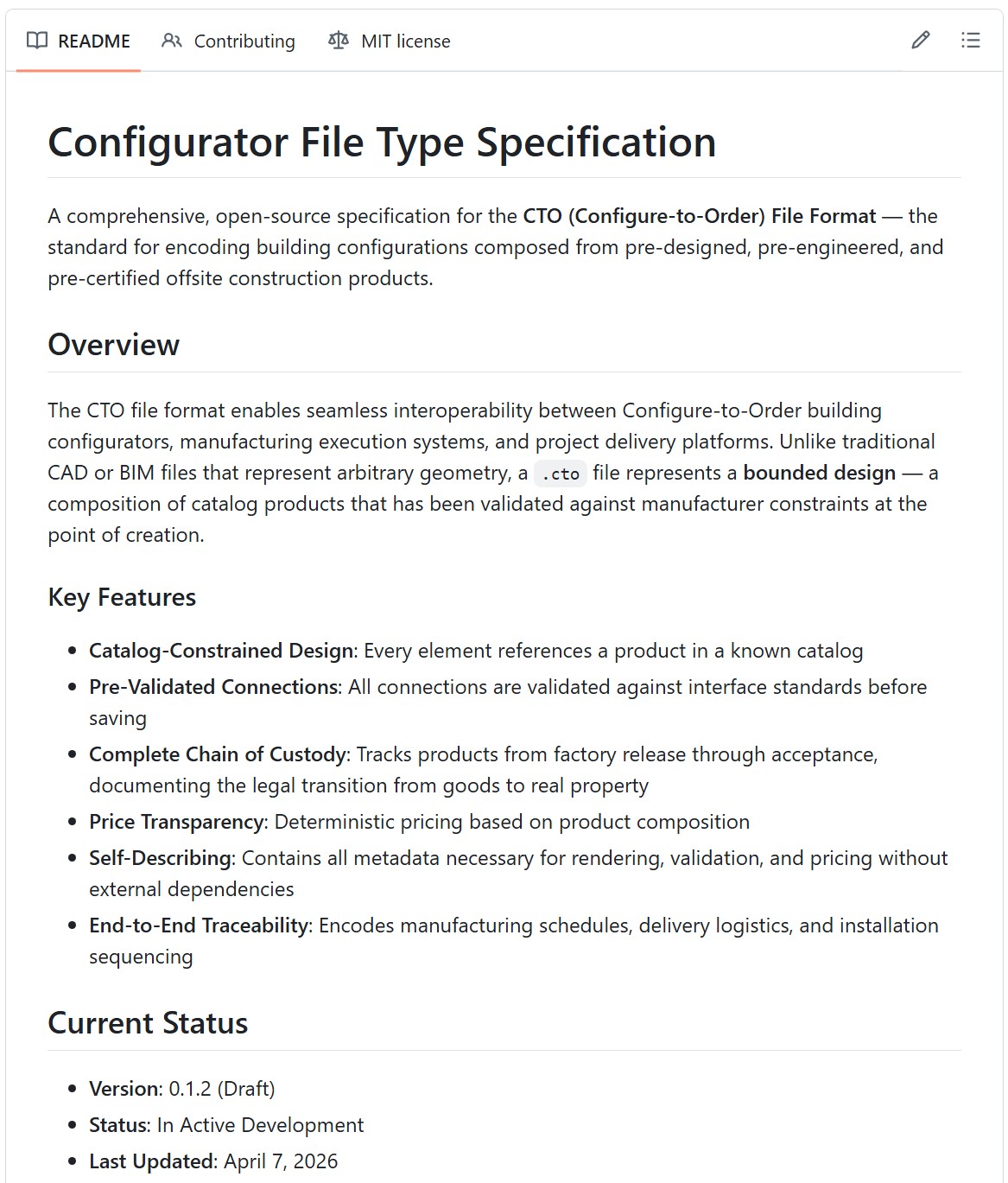
The whitepaper named the problem. Now we are excited to report that the .cto file format — the open standard CfOC is developing for Configure-to-Order construction — is beginning to encode the solution.
The Legal Mateline, Made Machine-Readable
The central concept in From Handshake to Hardware was the legal mateline: the boundary at which an offsite product transitions from a good governed by UCC Article 2 to real property governed by Common Law. We argued that this transition was the most consequential — and least documented — moment in the lifecycle of an offsite product. Warranties activate. Insurance policies shift. Title completes its transfer. And yet nothing in existing BIM or CAD file formats even acknowledged that this moment existed.
The .cto file type changes that. Every product instance in a .cto assembly file carries a chain of custody — a structured, timestamped record of every handoff from factory floor to acceptance. At each stage, the file records who holds title, who bears the risk of loss, and which insurance policy responds. The acceptance stage is formally defined in the spec as the legal mateline crossing, the moment at which legal_status transitions from fixture to real_property and warranties activate. This is not a narrative note buried in a PDF — it is a structured data field that software can read, validate, and act on.
UCC Article 2 and the Offer on the Table
One of the practical arguments in From Handshake to Hardware was that construction should move away from the vague handshake agreements of common law contract formation and toward the cleaner offer-and-acceptance framework of UCC Article 2 — the same legal framework that governs the sale of every other manufactured good in America. UCC Article 2 requires a clear price, a defined quantity, and a delivery commitment. Those three elements constitute a legal offer.
The latest version of the .cto spec (v0.1.3) now includes a price_quote object on every placed product instance. When a user is composing a home in a configurator, the system can query the manufacturer for a live price and ship date, and record both — along with a quote reference number, an expiration timestamp, and the manufacturer contact who provided it — directly in the file. Every product instance in the design has its own quote. A home with three bathroom pods of the same type carries three independent price quotes, each with its own ship date. When the user agrees to proceed, the file contains everything needed to constitute a formal offer under UCC Article 2. The handshake becomes a data record.
Warranties That Travel With the Product
From Handshake to Hardware also highlighted the fragility of warranty documentation in offsite construction — warranties that lived in PDF attachments, didn't survive ownership transfer, and provided no clear record of when they activated or what they covered. The .cto spec addresses this at two levels. First, warranty terms are embedded directly in the product definition file authored by the manufacturer — structural warranty duration, finish warranty, MEP systems warranty — and those terms travel with every reference to that product. Second, at the moment of acceptance, the chain of custody records warranty_activation with explicit start dates and expiration dates for each warranty category, plus embedded_warranty_transfers that document the transfer of appliance and sub-component warranties to the new owner by name.
What Comes Next
We want to be clear that this work is still a draft — version 0.1.3 of an open specification that we are actively developing through CfOC's ANSI-accredited consensus process. There are gaps we have already identified. The spec does not yet include a lien_holder or financing field in the chain of custody, which means the legitimate questions lenders have about collateral status during construction are not yet fully addressed. In-factory handoffs — the stages before a product leaves the manufacturing floor — are tracked at the production schedule level but do not yet carry the full legal custody record structure that post-factory stages do. These are natural candidates for future versions.
What excites us is the direction. From Handshake to Hardware was a diagnosis. The .cto file format is the beginning of a prescription — a shared, open, machine-readable standard that encodes legal clarity into the digital infrastructure of offsite construction. We invite manufacturers, software developers, legal professionals, and industry partners to engage with the draft specification on GitHub, open issues, propose changes, and help us build the data standard that Configure-to-Order construction deserves.
The spec is open. The conversation is open. Come build with us.
The CTO file format specification is published under the MIT license at github.com/Jason-Van-Nest/configurator-file-type-spec. The CfOC whitepaper From Handshake to Hardware is available at centerforoffsiteconstruction.org.